On-Demand Service Platforms: Architecture for Home Services Apps
Technical deep-dive into building SiMahir, an on-demand home services platform handling laundry, AC repair, electrical, and plumbing services.

Featured Project
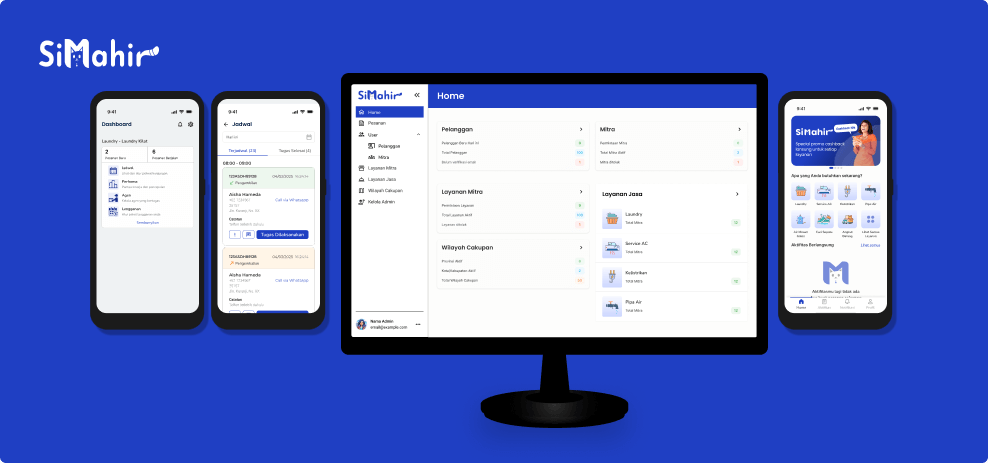
The on-demand economy has transformed how we access services—from rides to food to home repairs. Building SiMahir, a home services platform connecting Indonesian households with skilled professionals for laundry, AC servicing, electrical work, and plumbing, taught us how to architect platforms that handle the unique complexity of service marketplaces.
The Home Services Challenge
Unlike product marketplaces, service marketplaces must handle:
- Time-based inventory — Professionals have limited hours
- Geographic constraints — Services are delivered in person
- Variable scope — Jobs rarely go exactly as planned
- Trust requirements — Strangers entering homes
- Quality control — Ensuring consistent service standards
SiMahir needed to solve all of these while being accessible to users with varying technical sophistication.
Platform Components
Customer Mobile App
The customer app needed to make booking services as easy as ordering food:
Service Selection:
- Browse available services by category
- View pricing and estimated duration
- See provider ratings and reviews
- Check real-time availability
Booking Flow:
- Select service type and specifics
- Choose date and time slot
- Add address and access instructions
- Confirm and pay
Active Job Tracking:
- Provider en-route tracking
- Real-time status updates
- Direct communication with provider
- Emergency support access
Provider App
Service providers needed tools to manage their work efficiently:
Availability Management:
- Set working hours and days
- Block time for breaks or personal appointments
- Manage service area coverage
- Handle emergency schedule changes
Job Management:
- View upcoming appointments
- Accept or decline new requests
- Navigate to job locations
- Document work with photos
Technical Architecture
Scheduling Engine
The heart of an on-demand platform is its scheduling system. Ours handles:
Availability Calculation:
- Provider working hours
- Existing bookings
- Travel time between jobs
- Buffer time for overruns
Smart Matching:
- Skills matching (not every technician handles every job)
- Geographic optimization
- Provider preferences
- Load balancing
Location Services
Home services require sophisticated location handling:
Address Management:
- Indonesian address parsing (often non-standard)
- Landmark-based instructions
- GPS coordinate capture
- Access point documentation
Routing:
- Optimal route calculation
- Real-time traffic consideration
- Multi-stop optimization
- Arrival time estimation
Handling the Unpredictable
Home services rarely go exactly as planned. We built systems to handle the unexpected:
Scope Changes
When a simple AC cleaning reveals a bigger issue:
- Mid-job scope expansion workflow
- Customer approval required
- Price adjustment transparency
- Documentation requirements
Cancellations and Rescheduling
Life happens on both sides:
- Flexible cancellation policies
- Automatic rescheduling options
- Provider protection for last-minute cancellations
- No-show handling
Results
SiMahir has achieved strong product-market fit:
| Metric | Achievement |
|---|---|
| Service Categories | 4 (Laundry, AC, Electrical, Plumbing) |
| Average Rating | 4.7 / 5.0 |
| Repeat Booking Rate | 65% |
| Provider Satisfaction | 4.5 / 5.0 |
Key Learnings
1. Provider Experience Matters Equally
Happy providers deliver better service. Investing in provider tools and support pays dividends in customer satisfaction.
2. Transparency Builds Trust
Clear pricing, real-time tracking, and honest communication reduce anxiety when letting strangers into your home.
3. Design for Edge Cases
The unusual situations—scope changes, no-access, disputes—define customer experience more than smooth transactions.
4. Local Context is Critical
Payment preferences, address formats, communication styles—everything needs localization beyond simple translation.
On-demand service platforms are complex organisms with many moving parts. Success comes from relentlessly focusing on the experience for all participants—customers, providers, and operations teams—while building technical infrastructure that can handle the inherent unpredictability of real-world services.